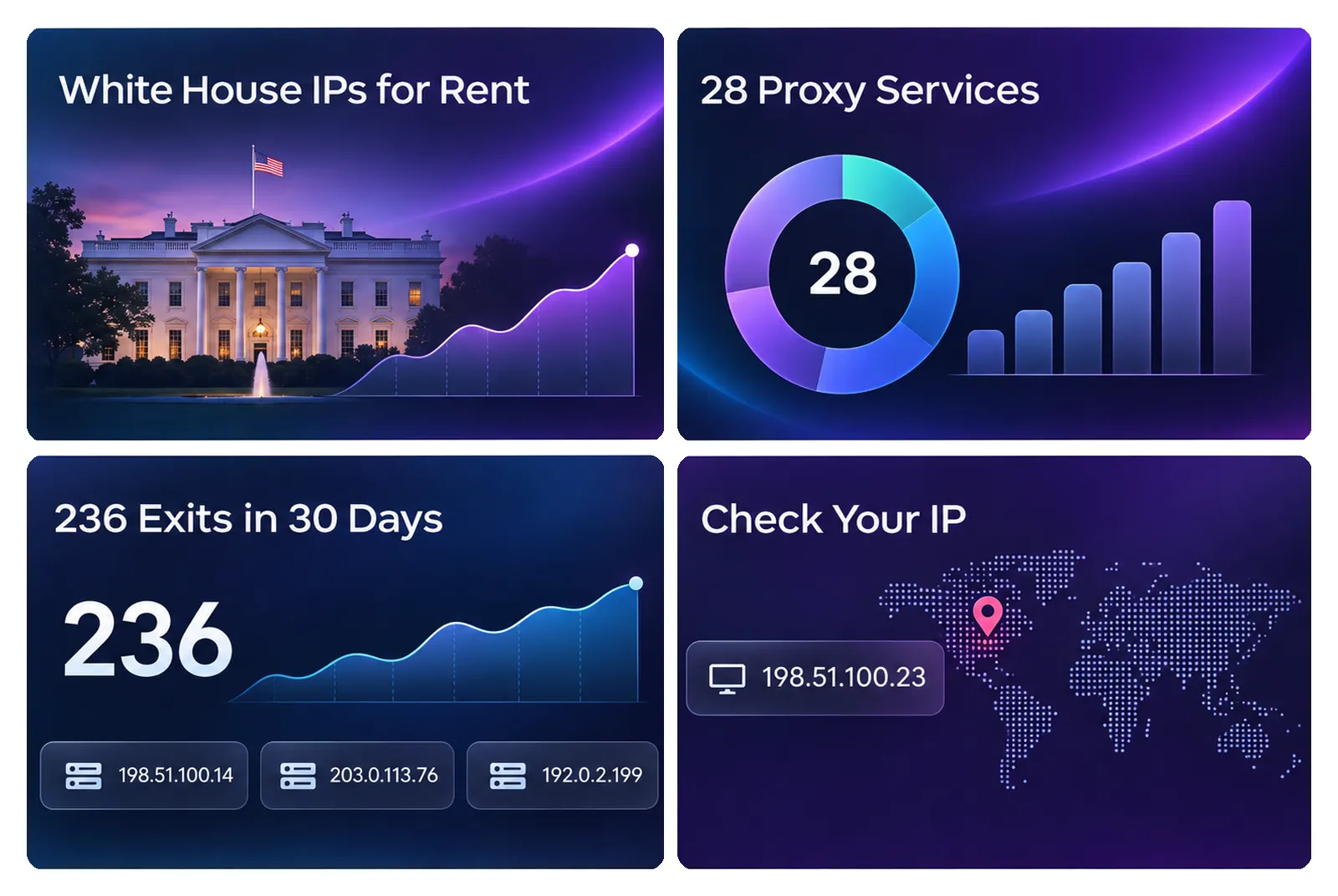
TL;DR: Researchers at Layer3 Intel found addresses on the White House network block (AS2650, registered to the Executive Office of the President) listed for rent across 28 residential proxy services. Over 30 days their tools exited through the network 236 times, from 6 addresses on 26 of the 30 days. The most likely cause is a single personal device carrying proxy software — not a breach, and not an official arrangement. The lesson is blunt: an IP's reputation says nothing reliable on its own. Any address, even one belonging to the White House, can end up as a proxy exit without its owner knowing.
If an IP address could have a pedigree, an address on the White House network would be it: a US government block, registered to the Executive Office of the President, about as far from a shady datacenter as an address can get. In October and early November 2026, that pedigree meant nothing. Those addresses were for rent — listed across 28 residential proxy services, available to anyone with a few dollars, ready to carry strangers' traffic as if it came from inside one of the most guarded networks on earth.
No one hacked the White House to do it. That is the point.
What happened
Layer3 Intel, a research team that tracks proxy infrastructure, found the addresses while testing its new Residential Proxy Observatory, a tool that maps proxy activity worldwide. The team was not looking for the White House. It simply bought rotating access from proxy services and watched where its traffic came out. The White House addresses came up on their own.
The numbers, from Layer3 Intel's observations between October 5 and November 3, 2026:
| Proxy services listing the addresses | 28 |
| Network block | AS2650, registered to the Executive Office of the President |
| Exits observed in 30 days | 236 |
| Distinct addresses | 6 |
| Days with at least one exit | 26 of 30 |
Two other proxy-detection firms, Spur and Synthient, independently list the same addresses as proxy exits, which makes a one-off measurement error unlikely.
The most likely explanation: one device, in the evening
About half of the exits happened between 5 p.m. and midnight Eastern time, and almost none in the early morning. That pattern looks like one person on the network in the evening — not a public guest Wi-Fi setup, and not a server running around the clock.
Layer3 Intel's most likely explanation is a personal device carrying a proxy software kit: a bandwidth-sharing app, a "free VPN" or utility app with a proxy SDK buried inside, or a cheap device with proxy code preinstalled. The data shows only the exits. It does not show which device or person is behind them, and the researchers are careful to say so. Nothing in the finding suggests the White House itself sold access, or that any classified system was involved.
That restraint matters, because the mechanism is ordinary. Proxy SDKs pay app developers and device makers for the bandwidth of whoever installs them. The owner of the device rarely agrees knowingly — the permission is buried in terms nobody reads, or the code is preinstalled at the factory. The device then rents out its connection, and the network it sits on inherits the reputation consequences.
Why "residential" proves nothing
This is the same pattern ipready.cc has been documenting all year, and it keeps getting bigger:
- XCPE (November 2026): Google led a takedown of a botnet hidden in the firmware of more than 1.3 million Android TV boxes. The boxes quietly became residential proxy exits, and their owners never knew. Read our breakdown: 1.3 Million TV Boxes Became Residential Proxies. Their Owners Never Knew.
- Kimwolf: an earlier botnet that reached more than 2 million devices, mostly Android boxes with an open debug service, spreading through residential proxy networks. Attackers used it to reach devices on private home networks that should have been out of reach.
- Smart TVs: later research found that nearly half of the apps on LG and Samsung TVs carried proxy code.
- IPIDEA: a proxy network Google disrupted, built on hidden software kits inside ordinary apps.
The White House finding belongs in the same list, and it is the most vivid entry in it. If addresses on a presidential network can be rented as proxy exits, then no address is clean by pedigree. A "US residential IP" can be a stranger's TV box, a phone running a bandwidth-sharing app, or a device on a network whose owner has no idea it is for rent. Simple blocklists often miss these addresses precisely because they look normal — that is what makes them valuable to proxy sellers.
Layer3 Intel found the same pattern in the places you would least expect: 413 addresses and more than 32,000 observations in Saint Helena, Ascension and Tristan da Cunha; three observations in Antarctica, all from a Cloudflare WARP address tied to McMurdo Station; and smaller counts from the Falklands, the Chagos Islands, Tokelau and South Georgia. Wherever there is a device with proxy code, there is an exit.
What this means if you run accounts
For cross-border sellers and multi-account operators, the practical consequences are direct:
- A "clean" residential IP can get you flagged anyway. If your exit address was recently rented out as a proxy, or is currently shared with strangers' traffic, platforms see the same signals they would see from a datacenter exit: many accounts, odd request patterns, abuse reports attached to the address. Our guide explains the flag itself: IP Flagged for Suspicious Activity? What It Means and What to Do.
- Geolocation is not identity. An exit that says "United States" says nothing about who is actually behind it. Our earlier piece covers how residential proxies defeat location checks: Residential Proxies Defeat Location Checks.
- Reputation is rented, not owned. An address's history follows it. A score that was good last month can turn after the address spends a week in a proxy pool. That is why a one-off check is not enough, and why we wrote What Is a Good IP Reputation Score? — to explain what the number actually measures.
Check your own IP before you trust it
Before running accounts, ads, or checkouts through an address, check the address itself. A free check at ipready.cc scans 12 signals: whether the IP is a known proxy or VPN exit, its ISP and ASN, DNS behaviour, blacklist listings, and recent abuse history, and turns them into an explainable risk score plus per-platform readiness for ChatGPT, Claude, Amazon, eBay and Binance.
What to look for in the result:
- Proxy / VPN / Tor card: any "suspected exit" verdict means the address is already in circulation as someone else's egress. Treat it as borrowed, not yours.
- ASN and ISP: a residential ISP name is not a clean bill of health — the White House addresses were on a government ASN. Read the ASN together with the exit and abuse signals, not instead of them.
- Recent abuse: reports attached to the address in the last days or weeks matter more than old history. Fresh abuse is the fingerprint of a recently rented exit.
- Risk score: our risk score guide explains how the score is built and what each band means in practice.
If you manage many addresses, the same checks run in bulk at ipready.cc/batch-check — paste up to 20 IPs and screen the whole list before use.
If your own IP shows up as a proxy exit
The White House case suggests the cause is usually a device on your network, not your router and not your ISP. Work through the devices:
- Check every device on the network, especially cheap Android TV boxes, phones with "free VPN" or "earn money sharing bandwidth" apps, and browser add-ons you do not recognise. Layer3 Intel's advice to network teams is the same: review apps and add-ons on work devices for proxy code.
- Remove bandwidth-sharing and unknown proxy apps, and turn off Android's debug service (ADB) where it is not needed. Kimwolf spread largely through that open service.
- Keep low-cost Android TV boxes off sensitive networks. If a box's firmware carries a proxy kit, it can expose the whole network — Synthient's Kimwolf research showed attackers reaching private home devices this way, and one bandwidth-sharing case gave outsiders a path to a router's management page.
- Re-check the address after cleanup, and again a few days later. Proxy listings can take time to age out of detection databases, and a fresh check is the only way to know the address is actually clear.
- If the address belongs to your ISP's shared pool (CGNAT or a shared exit), the cause may be a neighbour on the same address. Our MaxMind piece explains how shared IPs inherit each other's reputation: Shared IP, Wrong Location: MaxMind, CGNAT and IP Confidence.
FAQ
Was the White House hacked? No evidence of that. The finding is that addresses on its network block appeared as exits in residential proxy pools. The most likely cause, in the researchers' own words, is a personal device carrying a proxy software kit. The data shows exits only — not who operated the device, and not any access to White House systems.
Could my home IP be rented out the same way? Yes, and that is the point of the story. Any device on your network with proxy code — a bandwidth-sharing app, a free VPN, a cheap Android box — can enrol your connection without you knowing. Check the address, then check the devices.
Does this mean residential proxies are useless for legitimate work? No — it means "residential" is not a quality stamp. A residential address that is also a shared proxy exit carries the same platform risk as a datacenter one. Check the address's exit status and abuse history before you use it, whatever its category.
How do I know if an IP is a proxy exit? Run it through a checker that tests proxy and VPN exit signals, ASN, and abuse history together — one signal alone misleads. Our free check covers all of them at ipready.cc.
Sources
- Layer3 Intel research, as reported by Cyber Security News, November 5, 2026: researchers found White House network addresses (AS2650) listed for rent across 28 residential proxy services; 236 exits in 30 days (October 5 – November 3, 2026), from 6 addresses on 26 of 30 days; Spur and Synthient independently list the same addresses as proxy exits.
- Google Threat Intelligence Group / Plume joint announcement, November 2, 2026: XCPE botnet takedown — more than 1.3 million set-top boxes across 200+ countries.
- Synthient research on the Kimwolf botnet: more than 2 million devices, mostly Android boxes with an open debug service.