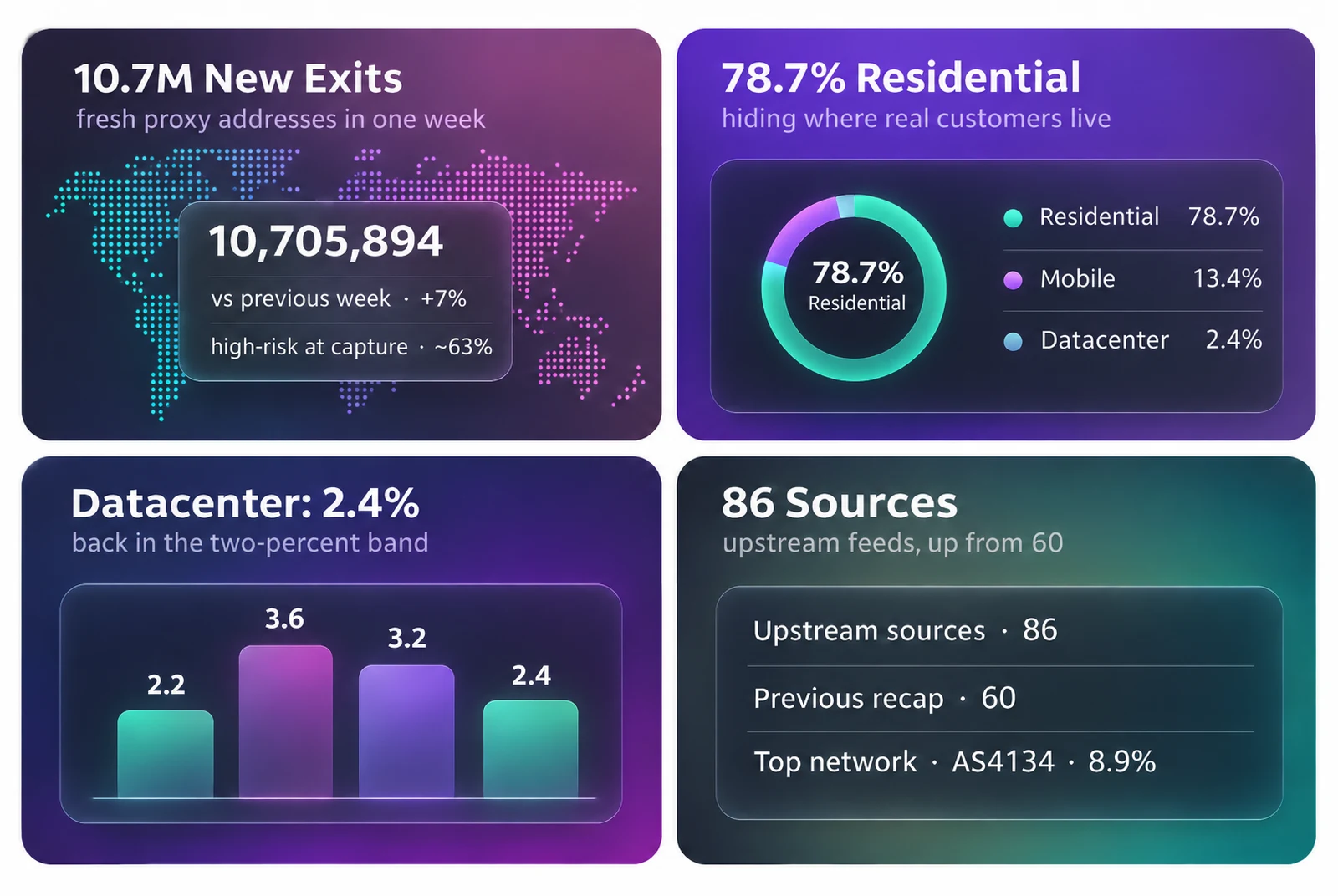
Every week, IP99 by ThreatHunter publishes a free census of the proxy supply its collectors actually saw: the exit addresses that newly appeared in its risk feed. The latest window, 12 – 18 November 2026 (UTC), captured 10,705,894 proxy exit addresses that had not been seen in the previous seven days — 7% more than the week before, per IP99.
Volume came back, but the mix did not flip. The datacenter share sits at 2.4%, up slightly from 2.2% in the last posted recap and back in the flat ~2% band of late October, after a brief rise to 3.6% and then 3.2% in the two weeks before that. More than nine in ten newly seen proxy exits still sit on residential and mobile networks, exactly where ordinary customers live.
The mix this week
| Usage type | Addresses | Share |
|---|---|---|
| Residential broadband | 8,425,688 | 78.7% |
| Mobile network | 1,431,350 | 13.4% |
| Gateway / NAT egress | 514,896 | 4.8% |
| Datacenter | 253,933 | 2.4% |
| Education network | 50,157 | 0.5% |
| Unclassified | 29,870 | 0.3% |
About 63% of the captured addresses were rated high-risk at the moment of capture. The rest still carried a proxy-class signal at a lower risk level.
Daily volume stayed in a 1.25–1.69 million band, lightest on 15 November (1,253,419) and heaviest on 16 November (1,691,075). Against the last posted recap's 9,914,335 addresses, the count is up about 8% — much of that step-up is compositional: heavier 16–18 November days replaced lighter 9–11 November days in the rolling window. This is the same pattern we reported in 10.6 Million New Proxy Exits This Week: the supply keeps renewing itself at roughly ten million fresh exits a week, and the datacenter slice — the part ASN and hosting blocklists can actually see — stays in low single digits.
Why 2.4% still is not "mostly datacenter"
If your defence is mainly an ASN or hosting blocklist, you are still looking past most of the problem. Residential broadband alone is 78.7% of this week's capture window. Mobile adds another 13.4%. Together that is 92% of newly seen proxy exits sitting in access networks where real customers also live.
And usage type answers "what kind of network is this," not "is this address currently being sold as an exit." Rotating residential proxies and dial-up pools are designed to sit inside residential and mobile space. A lasting network-type label cannot catch them; detecting them takes supply-side observation with an age attached — per-address evidence, not a permanent tag on a network block.
Which networks show up most
The three largest contributors are unchanged: AS4134 (947,700 addresses, 8.9%), AS4837 (707,646, 6.6%) and AS9808 (358,103, 3.3%), followed by AS6057 (276,201, 2.6%). The one move in the top five is fifth place: AS55836 (259,403, 2.4%) is back in, after sitting eighth in the last two posted recaps, while AS36903 drops to seventh (2.0%).
Large access networks appearing here are a clue about where proxy supply is being sold from — not a claim that every customer on those networks is a proxy. Ban a whole ASN and you take out legitimate home and mobile users with it. Prefer per-address evidence.
What to do with this
Branch on evidence, not network type. Residential is where your customers live; a residential or mobile label alone is not a reason to hard-block.
Step up, don't stop. A fresh proxy-class signal at signup, a coupon claim, or a login from a new device justifies a second factor, a delay, or a manual review. An instant ban punishes the hijacked and the resold along with the abusers.
Read the age. An address seen in proxy supply weeks ago and quiet since is a weak signal; an address captured this week is a strong one. Re-check at decision time rather than caching a verdict for days.
That is the check we built IP Ready for: paste an address and see its current risk score, its proxy/VPN/Tor and abuse signals, and how the major platforms are likely to treat it — based on what the address looks like now, not on which network block it happens to sit in.
How IP99 counts (read this before quoting the numbers)
IP99 counts an address as "captured" when it enters the feed carrying a proxy-class signal (proxy, VPN, dial-up pool, cloud phone, or hijacked shared proxy) and was not in the live 7-day risk mirror; an address that goes quiet and returns can be counted again. The figures describe what 86 upstream collection sources delivered — not the total proxy supply of the world — and no address lists are published. The source count jumped from 60 in the last posted recap; IP99 reports the jump without giving a cause, and we won't invent one. The score on a single lookup reflects the freshness and strength of verifiable risk evidence, not a probability that the address "is an attacker."
Source: IP99 by ThreatHunter, "This Week's Proxy Exits: 10.7M New Addresses, Still Almost All Off Datacenter Space" (data window 12–18 Nov 2026, published 19 Nov 2026).