TL;DR
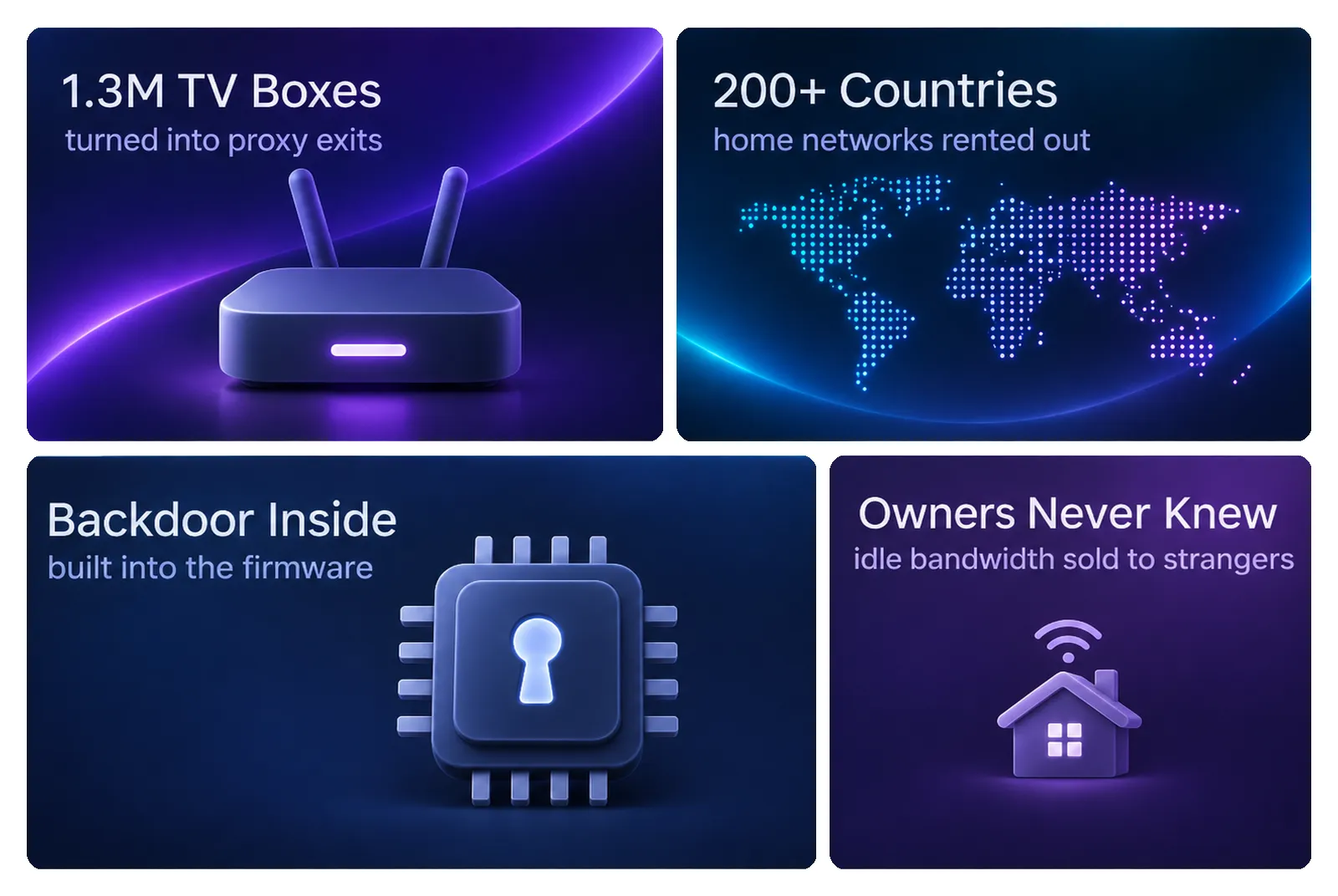
- On November 2, 2026, Google announced the takedown of XCPE, a botnet hidden in the firmware of cheap Android TV boxes: more than 1.3 million devices in over 200 countries, infected before they ever reached a living room.
- Most infected boxes were turned into residential proxy exits, or had their idle bandwidth sold. Strangers' traffic went out through ordinary home broadband — and looked like ordinary home traffic.
- For anyone who buys or uses residential IPs, the lesson is uncomfortable: the "residential" label describes the network an address sits on, not what that address has carried. A residential IP you receive today may have spent its previous life as a botnet exit.
- The takedown disrupted the botnet's command servers — not the boxes. The backdoor lives in firmware and returns on reboot, so this pool does not drain overnight.
What happened
The operation was led by Google, working with Japan's National Police Agency, Lumen, HUMAN Security, Plume, Synthient, and TrendAI (Trend Micro's research arm), and announced on November 2, 2026. The target was XCPE, a botnet whose malware did not arrive through a dodgy download or a phishing link. According to the takedown partners, a backdoor was pre-installed in the firmware of low-cost Android TV boxes — present before purchase, with, in Plume's words, no user knowledge, consent, or opt-out.
That detail matters. Most home-device infections involve something the owner did: a sideloaded app, a weak password, an unpatched router. XCPE's owners did nothing at all. They plugged in a streaming box, and the box quietly joined a proxy network.
The business model was your home connection
A compromised TV box is not worth much as a computer. What it owns is valuable: a residential IP address on a real household connection.
Per Google's analysis, relayed by The Hacker News, most of XCPE's crime modules did one of two things with that asset: they turned the boxes into residential proxies, or they sold the devices' idle bandwidth. Third-party traffic — other people's browsing, scraping, account logins, and worse — was routed through the box and out of the home's broadband line. To any platform watching, that traffic arrived from a normal residential address, indistinguishable from the family streaming a film in the next room.
This is the supply side of the residential proxy market, at its ugliest: not households who knowingly installed a "earn from your bandwidth" app, but households who never agreed to anything.
The numbers, kept separate
Two different counts circulate in coverage of this story, and they measure different things:
| Figure | What it counts | Source / window |
|---|---|---|
| 1.3M+ devices, 200+ countries | Devices in the XCPE botnet at takedown | Google-led takedown announcement, Nov 2, 2026 |
| 1,472,554 devices, 206 models | Devices observed carrying the infection | TrendAI telemetry, Jun 3 – Oct 1, 2026 |
| 3.8M+ home and mobile IPs | Addresses the infected devices appeared on | TrendAI, same Jun – Oct window |
The TrendAI window closed a month before the announcement and used its own detection, so its device count is higher than the takedown headline — that is a difference in method and window, not a contradiction. The IP figure is the one worth pausing on: 1.47 million devices touched more than 3.8 million residential and mobile addresses in four months, because home IPs rotate. Every one of those addresses spent some time as a potential proxy exit.
What is alleged — and what is not proven
Google Threat Intelligence assesses with high confidence that the box manufacturer, Videostrong, deliberately implanted the backdoor and sold access to crime affiliates. That is an assessment by a vendor's research team — a serious one, from the team that led the takedown — but it is not a court conviction, and Videostrong did not respond to press queries. Treat the attribution as alleged, however strong the sourcing.
The infection itself, the proxy modules, and the takedown are documented by multiple independent participants. Who profited, and with what intent, is the part still awaiting a courtroom.
A takedown is not a cleanup
The operation seized or disrupted XCPE's command-and-control domains and servers — the infrastructure that told the boxes what to do. It did not, and could not, reach into 1.3 million living rooms and reflash the firmware. The backdoor persists on the devices and, per the researchers, reinstalls itself on reboot. Real cleanup requires action from device vendors, platform-level protections, or owners replacing the boxes — none of which happens on takedown day.
One headline figure deserves a correction before it spreads: the "another 10 million devices cut off" number refers to other infected devices, compromised through different channels by the same affiliates, losing access to the seized infrastructure. It does not mean 10 million — or any — XCPE boxes were cleaned.
We have seen this shape before: a seizure makes headlines, while the underlying addresses and devices stay exactly as dirty as they were the day before. Enforcement changes who controls a botnet; it does not reset the history of the IPs that passed through it.
What this means if you buy or use residential IPs
"Residential" is a network type, not a character reference. It tells you an address belongs to a household ISP range. It says nothing about who else has sent traffic from that address, or what that traffic did. The differences between residential, datacenter, and mobile IPs are about how platforms perceive the connection type — none of them is a cleanliness guarantee.
An address can inherit a past it didn't earn — and so can you. If a home IP spent weeks as an XCPE exit, the abuse history, blacklist sightings, and proxy flags it collected stay attached to the address after the box is unplugged, after the household changes providers, and after the address is reassigned or resold into a proxy pool. When you receive that IP, you receive its file.
History fades, but not on announcement day. Risky-IP history decays as addresses churn — most newly flagged IPs go quiet within about a week, as October's risky-IP data showed. That is an argument for checking an address at the moment you plan to use it, not an argument for assuming a formerly bad address is fine now. Between the two errors — trusting an old "clean" result and trusting an old "dirty" one — the fix is the same: a fresh IP risk score, read at the time of use.
A check describes an address; it cannot launder one. If an IP comes back with proxy signals and an abuse history, no tool makes that history disappear. The useful decision is the boring one: don't build an important account on an address whose past you can't account for.
FAQ
What is XCPE?
XCPE is the name given to a botnet found pre-installed in the firmware of low-cost Android TV boxes. At the time of the November 2, 2026 takedown announcement, it covered more than 1.3 million devices in over 200 countries. Its main business was converting the boxes into residential proxy exits and selling their idle bandwidth.
Could my own TV box be part of it?
The takedown partners did not publish a consumer self-test, and the backdoor operates below the level of anything an owner would see — no app, no prompt, no opt-out existed. The exposure was concentrated in cheap, off-brand Android TV boxes that shipped with the malware already in firmware. If a no-name streaming box in your home has always run oddly hot or busy, this is the category of problem it could belong to; the realistic fixes are a vendor firmware update or replacing the device, not anything you can toggle in settings.
Does the takedown mean those 1.3 million IPs are clean now?
No. The operation disrupted command-and-control servers; the backdoor remains in the boxes' firmware and survives reboots. Separately, even a fully cleaned device would not erase its address's history — blacklist entries and abuse records attached to an IP fade on their own schedule, not on the day of a press release.
Can a real home connection still be a risky IP?
Yes — that is the central lesson of XCPE. The connection is genuinely residential and the household is genuinely innocent, while the address's traffic history includes whatever strangers routed through it. "Residential" and "clean" are answers to two different questions.
What should I check before using a residential IP for an important account?
Check the address itself, as close to the moment of use as you can: its risk score, blacklist status, proxy/VPN signals, and abuse history. A clean result from weeks ago describes an address that may have had a different life since — and after XCPE, "a different life" includes the possibility that it was a botnet exit.
Sources
- Plume newsroom, "Google leads industry takedown of botnet hidden in more than 1.3 million set-top boxes across 200+ countries" (Nov 2, 2026): https://www.plume.com/newsroom/google-leads-industry-takedown-of-botnet-hidden-in-more-than-1-3-million-set-top-boxes-across-200-countries
- The Register, "Cops bust botnet of 1.3M infected Android TV boxes" (Nov 2, 2026): https://www.theregister.com/cyber-crime/2026/11/02/cops-bust-botnet-of-13m-infected-android-tv-boxes/5307045
- The Hacker News, "Google disrupts 1.3 million-device XCPE botnet" (Nov 2026): https://thehackernews.com/2026/11/google-disrupts-13-million-device.html
Note on figures: device and IP counts above are as published by the takedown participants and TrendAI's telemetry; counts differ because they cover different windows and detection methods. The attribution of intent to the device manufacturer is Google Threat Intelligence's assessment, reported as such, and has not been tested in court.