TL;DR
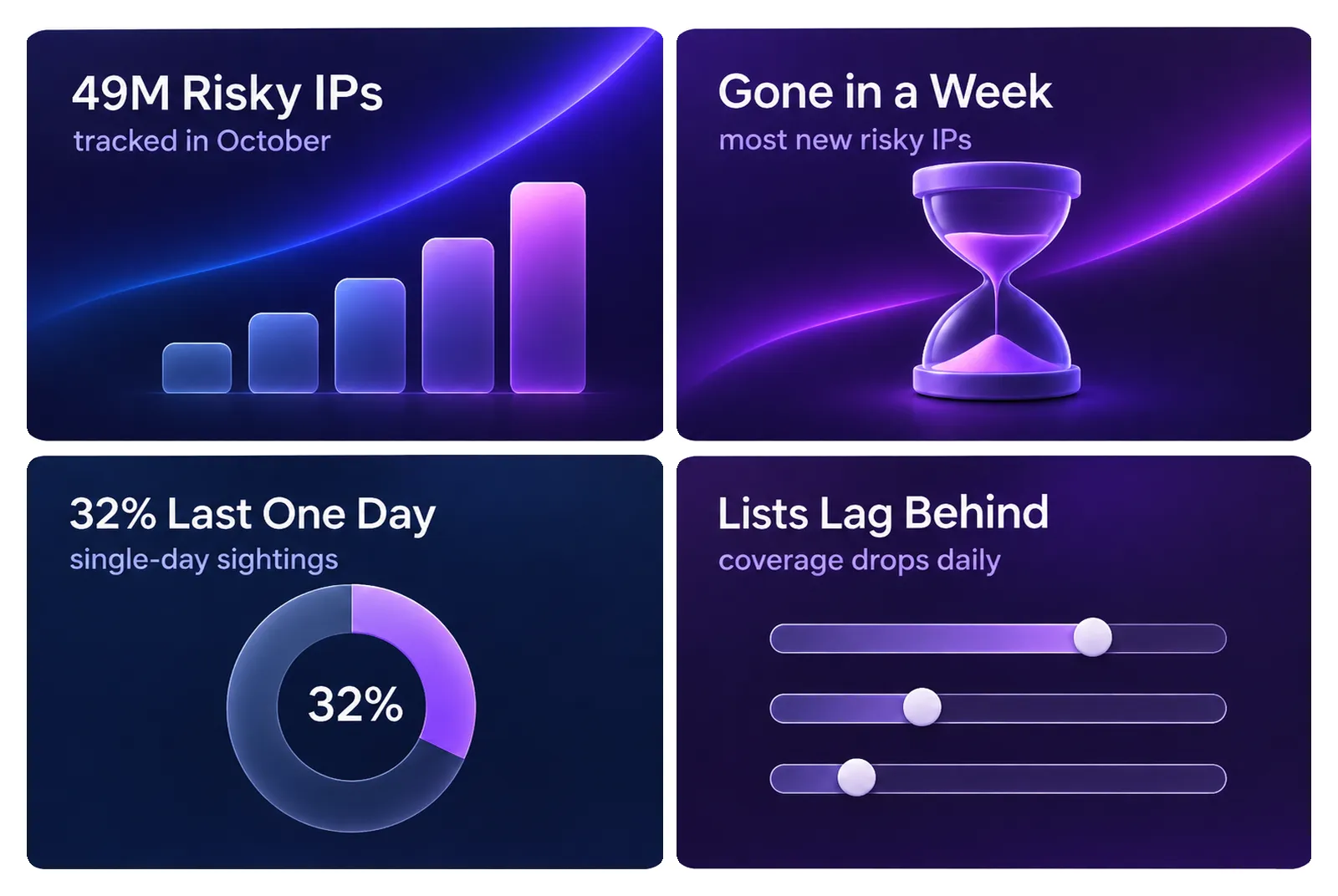
- ThreatHunter tracked roughly 49 million risky IPv4 addresses between September 27 and October 25, 2026 — about 1.3% of all routable IPv4, or 1 in every 75 public addresses.
- Risky IPs churn fast: 32% of newly seen risky IPs appear for only one day, half are gone in about five days, and only 42.3% are still active on day 7.
- Blocklists decay just as fast. A rolling 7-day list refreshed the same day covers 84.2% of active risky IPs; let it lag a week and coverage drops to 67.1% — a third missed. Another 15.8% of each day's risky IPs have no history in the prior 7 days at all.
- The risk is split between two populations: a persistent 14% of IPs (active 15+ days) generate 63% of risky activity, while the 32% that flash for a single day account for just 3%.
What ThreatHunter tracked
ThreatHunter's October 2026 research brief, October 2026 Risky IP Insights, is built on 29 days of global IPv4 telemetry (September 27 – October 25, 2026). The scale alone is worth noting: ~49 million addresses showed risky behavior in a single month. Of those, 77% sat on residential broadband, 10% on mobile networks, and only 6% in datacenters. Eighty percent operated as proxy exits, and 22% were hijacked shared residential proxies — ordinary home devices infected with proxy malware, whose bandwidth is resold by proxy platforms.
One caveat before the numbers: this is ThreatHunter's own research, drawn from its own telemetry — ThreatHunter is the company behind the IP99 risk-intelligence product. Treat the figures as one vendor's large-scale measurement, not an independent audit.
The headline finding is not the size of the risky-IP pool. It is how fast that pool turns over.
Risky IPs have a shelf life of about a week
ThreatHunter followed the cohort of risky IPs first seen between October 4 and 11, and tracked how many were still active in the days that followed:
| New risky IPs still active | Share remaining |
|---|---|
| Day 1 | 68.1% |
| Day 3 | 55.2% |
| Day 5 | ~50% |
| Day 7 | 42.3% |
| Day 14 | 24.8% |
A third of the cohort (32%) appeared on day 0 and never came back. Half were gone within roughly five days. Across the full 29-day window, nearly half of all risky IPs were no longer active by the final week.
A ban on a newly seen risky IP has an effective shelf life of about one week.
That cuts in both directions. Residential addresses get reassigned by ISPs, so a "risky" verdict pinned to an address can land on an innocent household a week later. And a blocklist built on last month's sightings is, in ThreatHunter's words, carrying dead weight: much of what it blocks is no longer a threat, which makes the entries it misses easier to overlook.
A week-old blocklist misses a third of active threats
The mirror problem is coverage. ThreatHunter measured how much of each day's active risky IPs a rolling 7-day blocklist ("every risky IP seen in the prior 7 days") would catch, depending on how stale the list is:
| Blocklist update lag | Coverage of that day's active risky IPs |
|---|---|
| Same day | 84.2% |
| 1 day | 79.5% |
| 3 days | 73.4% |
| 7 days | 67.1% |
| 14 days | 61.3% |
Every day of delay costs roughly 5 percentage points at first. And even a perfectly fresh list has a blind spot: 15.8% of each day's active risky IPs had not appeared at any point in the preceding 7 days. No static feed can pre-list an address it has never seen — those have to be caught by evaluating the IP when it shows up, not by looking it up in history.
This is also why the age of a verdict matters as much as the verdict itself: being listed is a state with a half-life, not a permanent label.
Two populations: the persistent 14% and the one-day 32%
Not all risky IPs churn. Split by how long they stayed active during the 29-day window, two very different groups emerge:
| Active duration | Share of risky IPs | Share of risky activity | Datacenter share | Still active in final week |
|---|---|---|---|---|
| 1 day only | 32% | 3% | 2% | 33% |
| 2–14 days | 54% | 35% | 4% | 56% |
| 15+ days | 14% | 63% | 24% | 95% |
The persistent minority — active 15 days or more — is where most of the actual harm concentrates: 14% of addresses producing 63% of the activity, with the top 10% alone driving 62%. These are also the IPs worth hard-blocking: 95% of them were still active in the final week.
The one-day flash IPs are the opposite problem. They are a third of all risky addresses but only 3% of activity, mostly on residential and mobile networks (81% of them outside China, just 2% in datacenters). By the time a list records them, they are gone. The risk they represent is not the address itself — it is whatever shared pool or infected device handed that address out for a day.
The geography: China is a special case
China accounts for 25.1% of all risky IPs in the dataset, and 89% of those are hijacked shared residential proxies — 93% of them on home broadband across the major carriers. In practice, that means a flagged address in China is usually an ordinary household whose router or device is relaying proxy traffic without the owner's knowledge. ThreatHunter's guidance for that segment is step-up verification rather than hard blocks, because a hard block punishes the household sharing the address.
Outside China the pattern is different: mostly dedicated proxy exits, with hijacked shared proxies under 0.1% in ThreatHunter's telemetry. That non-China pool is also growing — weekly active risky IPs outside China rose 29% across October to 20.66 million in the week of October 19–25, led by Brazil (7.9% of the global total), India (7.3%), and the United States (6.7%).
What this means if you rent or use IPs
A verdict has an expiry date. An IP that checked out as risky last week may be clean — or reassigned — today, and a "clean" result from last week says little about the address now. If a score matters to the task you are about to run, check it at the moment of use, not in advance. That is the entire premise of a live IP risk score: it describes the address as it stands now, not as it stood when some list was compiled.
Ask which population an IP belongs to. A datacenter address with weeks of continuous abuse history is the persistent profile — the worst kind. An address flagged once, briefly, on a residential range is more likely collateral from a shared or reassigned pool. Duration and repetition of the bad behavior matter as much as the flag itself.
Don't build decisions on a single stale list. If you maintain your own allow/block decisions, ThreatHunter's own recommendation to defenders is to put a 7–14 day TTL on IP bans and refresh daily — a reasonable rule of thumb for anyone keeping historical verdicts around. (That is ThreatHunter's guidance for list operators; it describes list hygiene, not something any particular checker does for you.)
Shared residential IPs inherit strangers' history. With 22% of risky IPs being hijacked shared residential proxies globally — and 89% of China's risky pool — an address you receive today may carry abuse history generated by people you have never shared anything with except an exit node.
FAQ
How long does an IP stay "risky" after it is flagged?
Often not long — but the flag can outlive the behavior. In ThreatHunter's October 2026 data, only 42.3% of newly seen risky IPs were still active on day 7, and 24.8% by day 14. The risky activity stops quickly; a static list entry, unless it expires, does not.
Why does a week-old blocklist miss so many threats?
Because the pool turns over underneath it. A rolling 7-day list covers 84.2% of a day's active risky IPs when refreshed the same day, 79.5% with a 1-day lag, and 67.1% after a week. Separately, 15.8% of each day's risky IPs are first-time appearances with no prior 7-day history, so they are invisible to any history-based list until after they act.
Are one-day "flash" IPs dangerous?
Individually, usually not for long — they make up 32% of risky IPs but only 3% of risky activity, and they disappear before most lists catch them. The persistent IPs are the bigger concern: 14% of addresses generating 63% of activity, and 95% of them still active in the final week of the observation window.
Why are so many risky IPs in China shared residential proxies?
ThreatHunter found that 89% of risky IPs in China are hijacked shared residential proxies, 93% of them on home broadband. These are compromised household devices whose connections are resold as proxy exits, so the address is simultaneously a real family's internet connection and a proxy exit used by strangers.
What should I do before using an IP for an important account or task?
Check its current state as close to the moment of use as you can: risk score, blacklist status, proxy/VPN detection, and abuse history — and weigh how long any bad history has persisted, not just whether a flag exists. A verdict from last week, in either direction, is stale evidence.
Sources
- ThreatHunter, "October 2026 Risky IP Insights" (research brief; observation window September 27 – October 25, 2026): https://www.threathunter.com/api/reports/october-2026-risky-ip-insights/download?locale=en
Disclosure: ThreatHunter is a commercial IP-risk intelligence vendor (the company behind IP99). All figures above are from its own telemetry and are reported as published; they have not been independently verified.