TL;DR — read this first
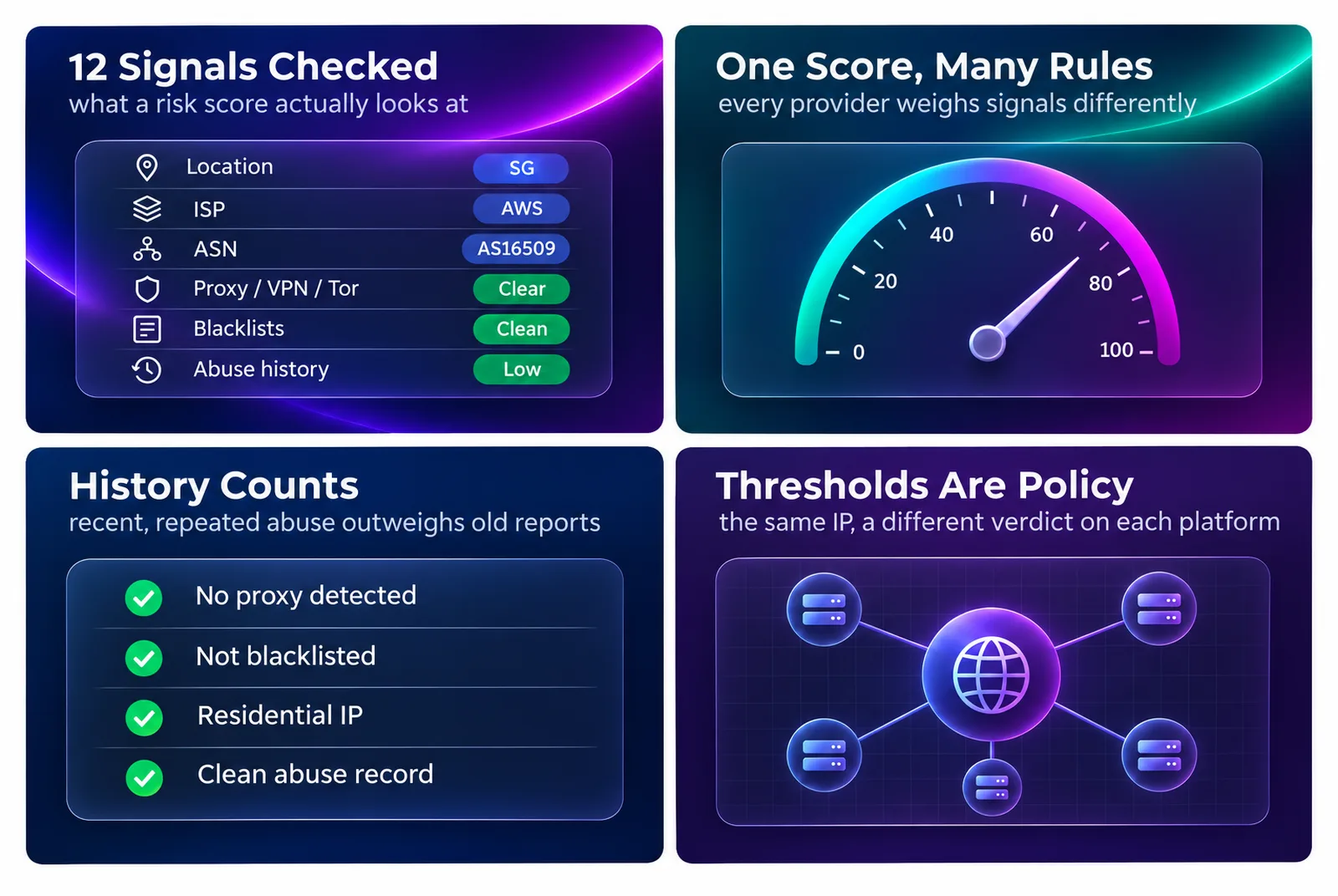
- An IP risk score is built from signals, not vibes: network type (hosting vs residential vs mobile), ASN ownership, proxy/VPN/Tor detection, blacklist presence, abuse history, geolocation consistency, DNS patterns, and whether the address is shared.
- The rules matter as much as the signals: providers weight signals differently, recent and repeated evidence counts more than old reports, and no single signal decides the score alone.
- Thresholds are policy, not physics. A bank, a streaming service, and an AI platform can look at the same score and reach three different decisions.
- On IP Ready, the number shown is a safety score = 100 − risk score, and it comes with per-platform verdicts — because the useful question is never just "what's my score?" but "will this platform accept this IP?"
Our pillar guide explains what an IP risk score is and how to read the 0–100 bands. This article goes one level deeper: the IP risk score signals that feed the number, and the IP risk score rules — weighting, recency, thresholds — that turn those signals into a decision.
The signals: what an IP risk score actually checks
Different providers name and group these differently, but the underlying evidence is largely the same. IP Ready scans a connection across 12 risk signals — including ISP, ASN, DNS, proxy/VPN/Tor detection, blacklists, and abuse history. Here is what each family of signals is really measuring.
Network type: hosting, residential, or mobile
The single most influential signal is usually what kind of network the IP lives on. An address belonging to a cloud or hosting provider (a datacenter IP) is treated differently from one assigned by a consumer ISP to a household, and both differ from a mobile carrier address.
This is not a moral judgment. Datacenter IPs are the right tool for servers, monitoring, and automation. But account sign-ups, logins, and checkouts overwhelmingly come from residential and mobile connections, so a hosting ASN is statistically unusual for those actions — and unusual is what risk systems are built to notice.
ASN and ISP ownership
Every IP sits inside an autonomous system (ASN) owned by some organization. Checkers look at who that owner is and what the range is normally used for: a national broadband ISP, a mobile carrier, a budget VPS host, a university, a corporate network.
Ownership also carries history. A range whose operator responds to abuse complaints and keeps its allocations clean tends to score better than a range known for ignoring them. Two IPs can behave identically today and still score differently because the neighborhoods they live in have different pasts.
Proxy, VPN, and Tor detection
An anonymizer signal means your traffic appears to exit through an intermediary rather than directly from your connection. Checkers build this from known VPN endpoint ranges, observed proxy exits, Tor exit node lists, and behavioral fingerprints of tunneling.
Commercial VPN exits are relatively easy to spot because thousands of subscribers share the same server addresses. A "proxy detected" flag does not mean you did anything wrong — it means the platform cannot see past the exit, and unseen is treated as riskier than seen.
Blacklist and RBL presence
Blacklists (and their DNS-based form, RBLs) are curated lists of addresses tied to spam, malware distribution, botnets, or policy violations. Being on a major list is one of the strongest negative signals a checker can find; being on an obscure or stale one may barely move the score.
What matters is which list, why, and how recent. If this signal is the one hurting you, our guide on why your IP is blacklisted walks through the causes and the removal process list by list.
Abuse and spam history
Separate from formal blacklists, reputation feeds record observed behavior: spam runs, credential-stuffing attempts, scraping, fraudulent sign-ups, port scanning. Two rules show up everywhere in how this history is used — recency (last week's incident outweighs one from three years ago) and repetition (a pattern outweighs a one-off). A clean recent window is how an address earns its score back over time.
IP reputation databases
On top of raw evidence sit reputation databases that aggregate everything above into their own scores, which other tools then consume. This is why checking your IP on two services can produce two different numbers that are both "reputation": they may be reading different aggregations, refreshed at different times, with different decay rules for old incidents.
Geolocation and timezone consistency
An IP's registered and observed location is compared against everything else the platform can see: the account's home country, the device timezone, the browser language, the payment method's country. The signal is not "wrong country = bad" — travelers exist. The signal is inconsistency: an IP claiming one country while the device clock sits in another, or an account that was in one place an hour ago and another continent now, starts from suspicion.
DNS and reverse DNS (PTR) patterns
Residential connections usually carry reverse DNS names that look like subscriber addresses from the ISP. Hosting ranges often resolve to server-style hostnames, and some addresses have no PTR record at all. No platform blocks you for a hostname — but as one tile in the mosaic, DNS patterns help confirm or contradict the network-type classification.
Shared IP and CGNAT ranges
When many people share one public address — carrier-grade NAT on mobile networks, corporate gateways, public Wi-Fi — the actions of every user tint the address for all of them. Checkers know this, and signals like a provider's shared-IP confidence exist precisely to soften (or confirm) the suspicion. The flip side: a shared address with heavy abuse from other users can drag down people who did nothing.
Behavior velocity — the signal a lookup can't fully see
Finally, an honesty note: platforms also watch live behavior — login attempts per minute, request rates, how fast an account moves through sign-up. That velocity layer sits on top of the static score and is only visible to the platform in the moment. A pre-check tool can show you the history and reputation side of the picture; it cannot show you a platform's live rate limits. Anyone who has never touched your account can still inherit a bad velocity reputation if the shared IP before them was hammering the same service.
The rules: how signals become a score
Rule 1: Signals are weighted, not counted
A score is not "seven checks passed, two failed." Each signal carries a weight, and weights interact. A datacenter ASN plus a fresh blacklist entry is far worse than either alone; a datacenter ASN with a long clean history may score better than a residential IP that was spamming last week. This interaction is why two addresses with the same "type" can land far apart.
Rule 2: No single signal decides — with one near-exception
In a well-built system, one flag raises scrutiny rather than delivering a verdict: proxy detected → more checks, not an instant block. The near-exception is a current listing on a major blacklist tied to active abuse, which many platforms treat as close to disqualifying on its own. Everything else is a combination game.
Rule 3: Thresholds belong to the platform, not the IP
The score describes the address; the decision threshold describes the platform's appetite:
- A bank protects accounts holding money, so it sets a low tolerance: mid-range scores trigger step-up verification, and anonymizer signals are treated harshly.
- A streaming service mostly enforces licensing geography, so it cares intensely about VPN/proxy signals and location — and much less about, say, an old spam listing.
- An AI platform fights automated abuse and bulk sign-ups, so datacenter ASNs, velocity, and fresh abuse history weigh heavily, while a slightly odd DNS pattern means little.
Same IP, same score — three different outcomes. This is also why "my IP works fine on X" proves nothing about Y.
Rule 4: Scores decay and drift
Risk data is perishable. Abuse feeds age incidents out, blacklist listings get removed, proxy ranges get reclassified, dynamic IPs change hands. A score is a snapshot with a shelf life, which is why checking before an important registration or login beats arguing with a decision afterward.
How to read your IP Ready result
IP Ready flips the raw number for readability: the score displayed is a safety score = 100 − the underlying risk score, to one decimal. A risk of 16.1 shows as 83.9 — higher displayed means safer, and the 低/中/高风险 (low/medium/high risk) badge states the direction plainly. The pillar guide's risk bands flip the same way: risk 0–29 corresponds to a displayed 71–100.
Below the score, four cards name the signals doing the work — Proxy, VPN/Tor, Recent Abuse, and Risk Score — under your basic connection information (location, time, browser). If your number surprises you, those cards tell you which signal family to investigate first.
Most importantly, the same evidence is then applied platform by platform, with readiness verdicts for Claude, ChatGPT, Amazon, eBay, and Binance. That is the rules layer made visible: one set of signals, five different thresholds, sometimes five different answers.
When your score is bad: a self-check routine
Treat this as an environment check, not a score-hacking exercise — platforms re-measure constantly, and a "fixed" number on one checker guarantees nothing elsewhere.
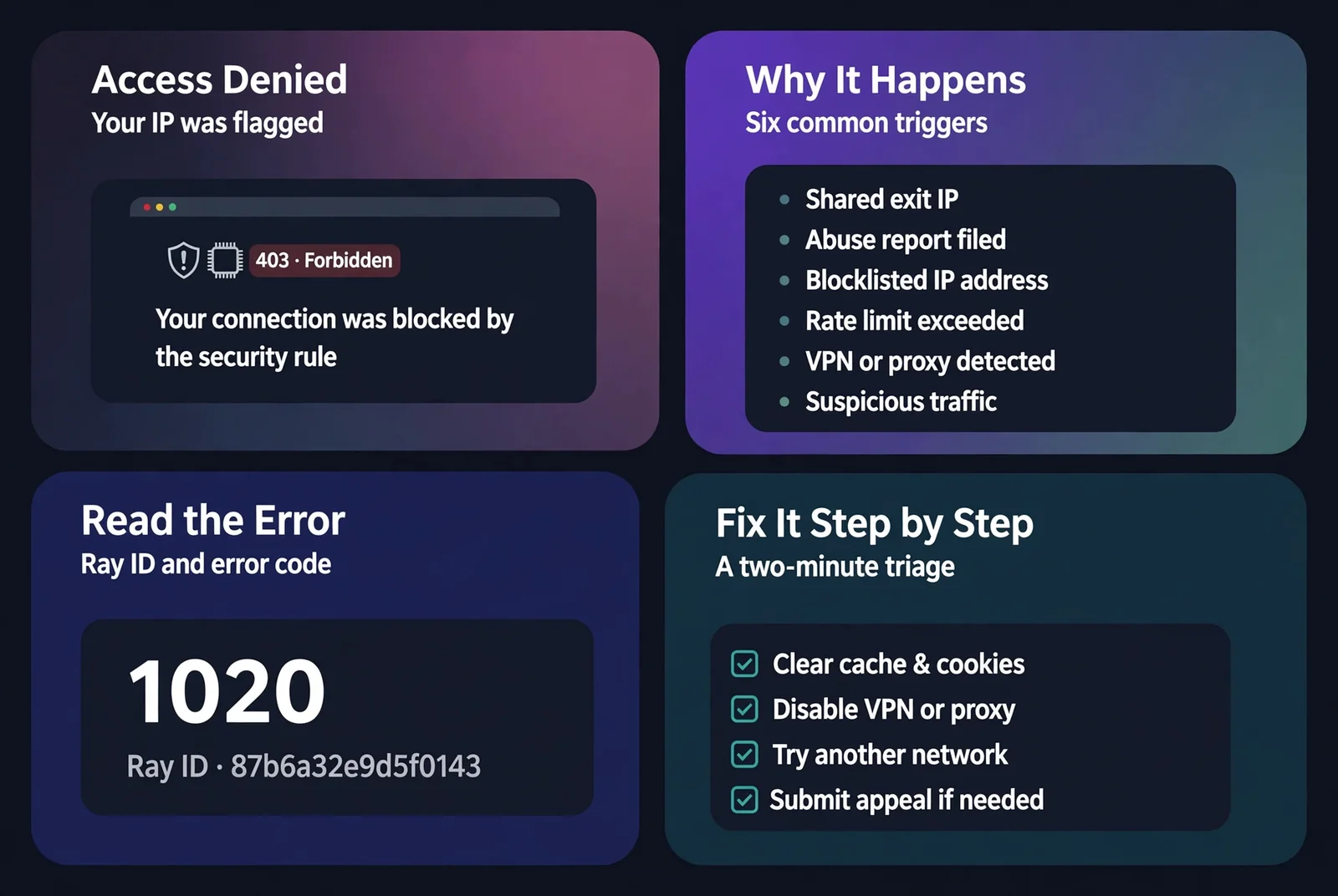
- Turn off the VPN or proxy and re-check. If the score recovers on a direct connection, the exit node was the problem, not you.
- Get off the datacenter exit for important accounts. Hosting ASNs start under suspicion at consumer platforms no matter how clean they are.
- Find the specific blacklist. If a listing is your main negative signal, identify the operator and follow its process — see why your IP is blacklisted for how.
- Restart or rotate a dynamic connection. Your ISP may hand you a different address; if the new one scores cleanly, the old address's history was the issue.
- Prefer a residential, dedicated IP for accounts that matter. A stable address used only by you stops inheriting strangers' behavior — the shared-IP problem disappears.
- Keep location and timezone consistent. Log in from the country your account expects, with a device clock that agrees with it.
- Re-check before the moment that matters. Scores drift; verify the address right before registering, logging in, or checking out, not a week earlier.
Check your current IP with IP Ready — free, no sign-up — and read the signals, not just the number.
FAQ
What are IP risk score signals?
They are the individual pieces of evidence a checker measures before calculating a score: network type and ASN ownership, proxy/VPN/Tor detection, blacklist presence, abuse history, geolocation consistency, DNS patterns, and whether the IP is shared. The signals are the facts; the score is their weighted summary.
What are the rules behind an IP risk score?
Signals are combined with weights rather than counted, recent and repeated evidence counts more than old isolated reports, and no single signal decides alone — a current major blacklist listing comes closest. The final pass/fail threshold is then set by each platform according to what it is protecting.
Why is my IP fine on one platform and flagged on another?
Because platforms weight signals differently and set different thresholds. A streaming service may only care that you are not behind a VPN; an AI platform may reject the same connection for its datacenter ASN. The IP did not change — the rules did.
Does a VPN always raise an IP risk score?
Almost always. VPN exits are shared by many users, frequently appear in abuse feeds, and hide the underlying connection, so the anonymizer signal plus shared history usually pushes the score up — even when your own use is completely innocent.
How can I check which signals are hurting my IP?
Run a check that shows the evidence behind the number. IP Ready scans your connection across 12 signals — ISP, ASN, DNS, proxy/VPN/Tor, blacklists, abuse history, and more — then shows your score with per-platform readiness for Claude, ChatGPT, Amazon, eBay, and Binance. Start from the signal cards, fix the cause, and re-check.
Methodology note: This guide was prepared with AI assistance and reviewed against public technical guidance. IP intelligence is dynamic, and third-party platforms make their own access and risk decisions.