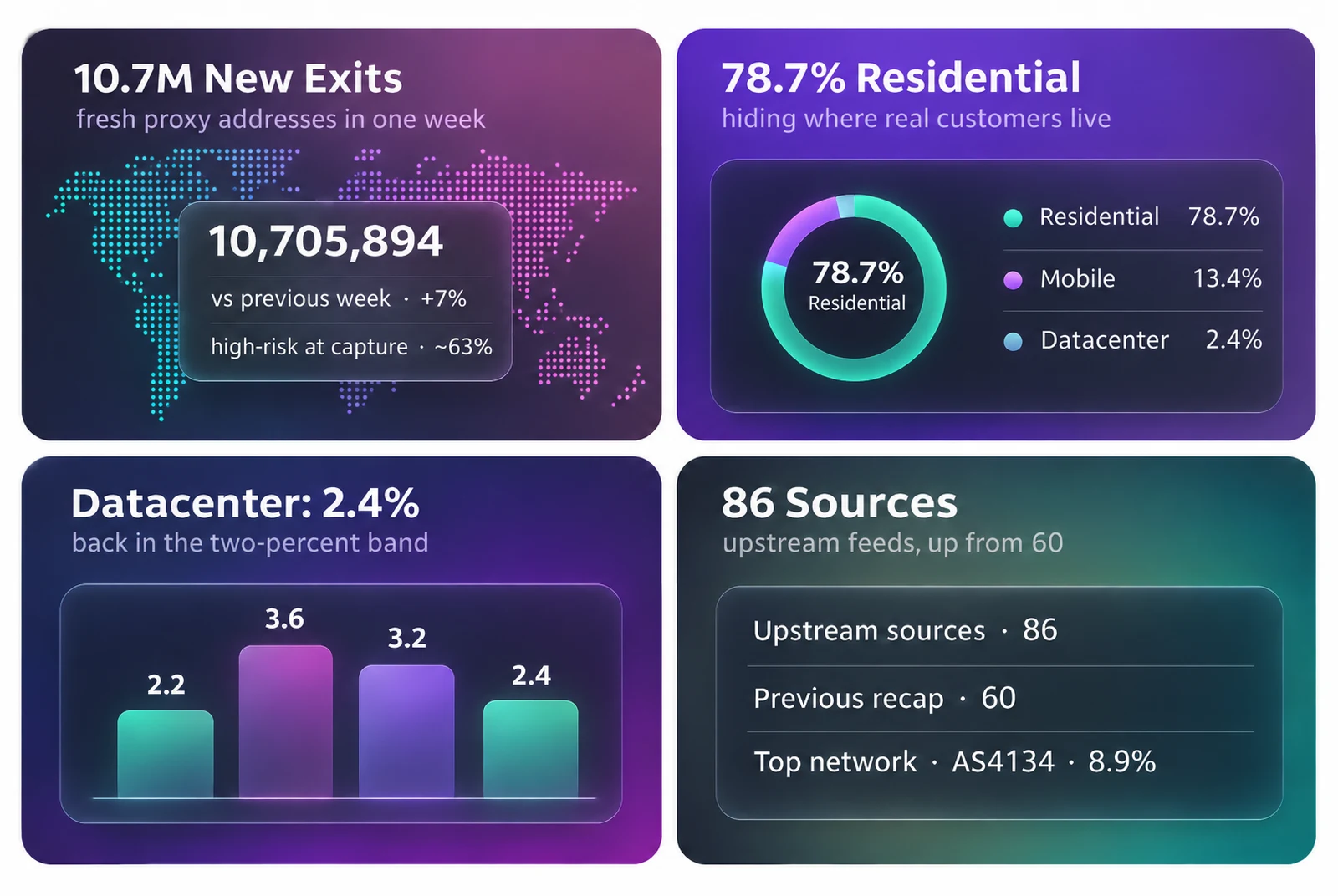
Between October 6–12, 2026, the IP99 risk feed captured 11,860,625 proxy exit addresses it had not seen in the previous 7 days — up 27% from the prior week. The volume is not the headline. Where they live is:
| Network type | New proxy exits | Share |
|---|---|---|
| Residential broadband | 9,427,787 | 79.5% |
| Mobile networks | 1,557,255 | 13.1% |
| Gateway / NAT egress | 536,041 | 4.5% |
| Datacenter | 260,684 | 2.2% |
| Education networks | 48,206 | 0.4% |
| Unclassified | 30,652 | 0.3% |
About 65% were rated high-risk at the moment of capture. The rest still carried a proxy-class signal at a lower risk level.
Your ASN blocklist is looking at the wrong 2%
Datacenter blocklists are still the default proxy defence in a lot of fraud stacks. This week's supply mostly was not in datacenters.
If your defence is mainly an ASN or hosting blocklist, you are mostly looking at that 2.2% datacenter slice. The other 98% is where the proxy market actually lives now:
Residential broadband proxies are home connections rented or sold as exits. To a platform, the address looks like an ordinary household going about its day. No datacenter ASN to flag, no hosting footprint to catch.
Mobile exits sit behind carrier-grade NAT, where hundreds of real phone users share one public address. Platforms cannot blanket-block those ranges without banning innocent users along with them — which is exactly why mobile exits are so valuable to proxy sellers.
Gateway / NAT egress (4.5%) is the grey zone in between: shared exits that are neither clearly residential nor clearly datacenter.
The rule of thumb IP99 states plainly: an address that keeps turning up in proxy supply is a proxy exit whatever its ISP label says.
The week's top ASNs include large access networks such as AS4134 and AS4837 — a clue about where supply is being sold from, not a claim that every customer on those networks is a proxy.
What this means if you run accounts that must stay trusted
"Residential IP = safe" is dead. The proxy market moved to where the real users are. A residential label tells you what kind of network the address sits on. It tells you nothing about what the address has been doing.
A clean ASN check tells you almost nothing. Only 2.2% of this week's newly captured exits would trip a datacenter block. Passing that check is no longer evidence of anything.
Proxy supply churns weekly. 11.9 million new exits in seven days — with a peak of 2.24 million on October 9 alone. An IP that was clean last week can be burned this week, and an exit that goes quiet can come back and be counted again.
Price is not a proxy for cleanliness. The expensive "residential" IP you just bought may have spent last week as someone else's proxy exit. Category is not reputation.
How to check an IP before trusting it with an important account
- Don't rely on a single signal. ASN, blacklist status, and network type each catch a slice. Check ISP and ASN, DNS, proxy/VPN/Tor signals, blacklist presence, and abuse history together.
- Check the IP you're actually exiting from, not the one you think you bought. What matters is the address the platform sees.
- Look at evidence, not just a category. Is the address showing up in proxy supply? Does it carry a proxy-class signal? Has it been associated with abuse?
- Re-check periodically. With supply churning at this rate, a one-time check has a short shelf life.
Where ipready.cc fits in
This is exactly the problem ipready.cc was built for. Our free scan checks your connection across 12 signals — ISP and ASN, DNS, proxy/VPN/Tor detection, blacklist presence, and abuse history — and turns them into one explainable risk score, plus per-platform readiness estimates for services like Claude, ChatGPT, Amazon, eBay, and Binance.
Blocking datacenters stopped being enough when the proxy market moved into living rooms and phone networks. Before you log an important account into a new IP, take 10 seconds to scan the address you're actually coming from. The category on the label won't save you — the evidence will.
Data: IP99 risk feed, Oct 6–12, 2026 (UTC) window, via dev.to. IP99 counts an address as captured when it enters the feed with a proxy-class signal and was not in the live 7-day risk mirror; addresses that go quiet and return can be counted again. The figures describe what IP99's 53 upstream collection sources delivered — not a census of all proxies worldwide.